By the tiswa editorial team, from the official sources listed at the end of this guide. How we write our guides
Research methodology terms in Arabic and English are needed at every stage of a graduation project, term paper or thesis: framing a research question, writing the method, analysing results and building the reference list. This guide lists 65 terms in five tables arranged by stage: research design, sampling and data collection, statistics, academic writing and references, and ethics and data management.
Universities sometimes phrase statistical and methodological terms differently. Treat your faculty guide and your supervisor as the final reference, and use this table to understand each term and compare the Arabic and English versions. If your study involves people or living beings, check the research ethics rules of the National Committee of Bioethics, which sets the regulations and accepts ethical review applications electronically. For earlier theses, the Saudi Digital Library hosts a repository of Saudi theses.
Research design
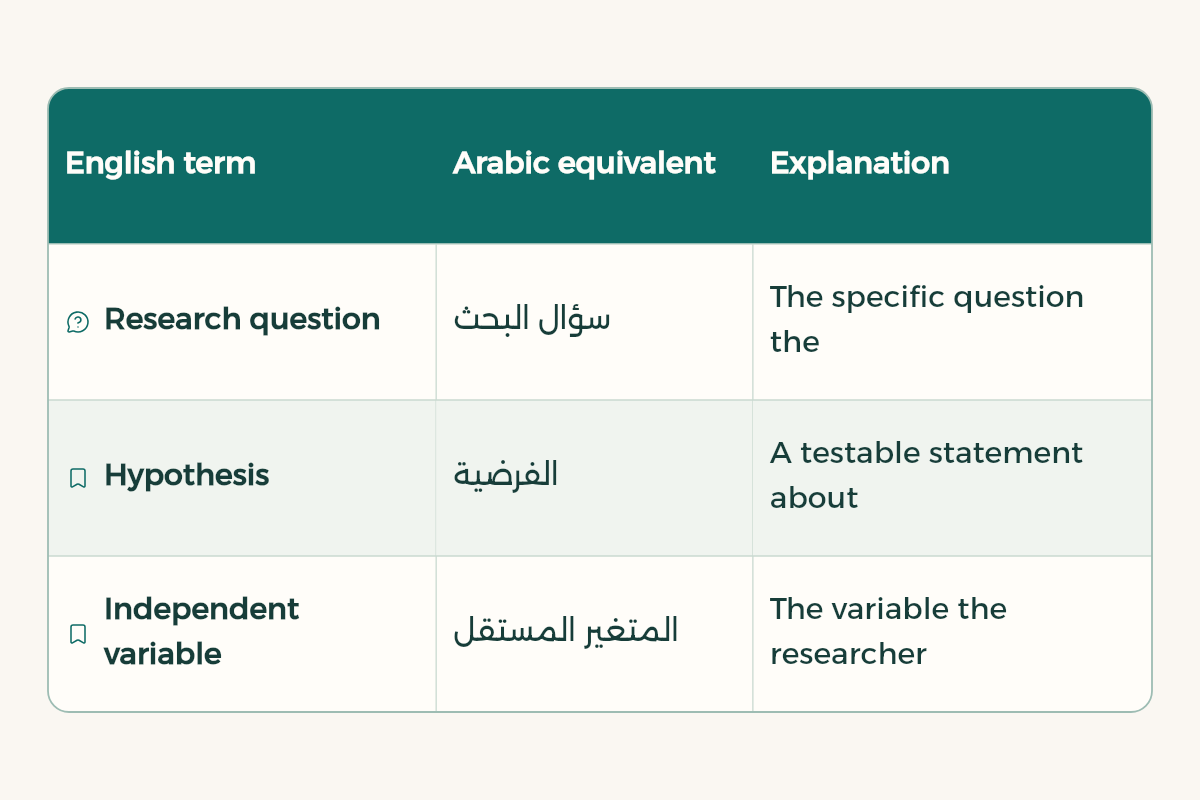
| English term | Arabic equivalent | Explanation |
|---|---|---|
| Research question | سؤال البحث | The specific question the study answers, and the one that guides every later step. |
| Hypothesis | الفرضية | A testable statement about an expected relationship between variables. |
| Independent variable | المتغير المستقل | The variable the researcher changes or measures as a possible cause. |
| Dependent variable | المتغير التابع | The variable measured to see the effect of the independent variable. |
| Control variable | المتغير الضابط | A variable kept fixed or monitored so it does not affect the result. |
| Confounding variable | المتغير المربك | An unplanned variable that affects both measures and creates a false link. |
| Experimental design | التصميم التجريبي | Plan that sets how participants receive the treatment and when the effect is measured. |
| Control group | المجموعة الضابطة | Group that does not receive the intervention, for comparison. |
| Experimental group | المجموعة التجريبية | Group that receives the intervention or the independent variable. |
| Case study | دراسة الحالة | In-depth study of one case or a few cases in their real context. |
| Qualitative research | البحث النوعي | Research that explores meaning, experience and context, using words and interviews. |
| Quantitative research | البحث الكمي | Research that measures phenomena with numbers and analyses relationships statistically. |
| Mixed methods | المناهج المختلطة | Combining qualitative and quantitative data in one study to strengthen the findings. |
Sampling and data collection
| English term | Arabic equivalent | Explanation |
|---|---|---|
| Population | مجتمع الدراسة | All the individuals or units the researcher wants to generalise to. |
| Sample | العينة | The part of the population from which data is actually collected. |
| Random sampling | العينة العشوائية | Selecting people so that each has a known chance of being chosen. |
| Convenience sampling | العينة المتيسرة | Choosing people who are easy to reach, which limits generalisation. |
| Stratified sampling | العينة الطبقية | Dividing the population into groups, then sampling within each group. |
| Sample size | حجم العينة | The number of participants needed for a reliable result. |
| Questionnaire | الاستبانة | Written set of questions that participants answer. |
| Survey | المسح | Collecting data from many people with a questionnaire or structured interview. |
| Interview | المقابلة | Guided conversation the researcher holds with a participant to collect views and experience. |
| Focus group | مجموعة النقاش | Group discussion moderated by the researcher on a set topic. |
| Observation | الملاحظة | Watching behaviour or a setting and recording it in a structured way. |
| Pilot study | الدراسة الاستطلاعية | Small trial before the full study, to test the instruments. |
| Validity | الصدق | How well an instrument measures what it was designed to measure. |
| Reliability | الثبات | How consistent the results are when the measure is repeated in similar conditions. |
Statistics and interpreting results
| English term | Arabic equivalent | Explanation |
|---|---|---|
| Descriptive statistics | الإحصاء الوصفي | Summarising data with averages, percentages and charts. |
| Inferential statistics | الإحصاء الاستدلالي | Drawing conclusions about a population from a sample, with stated uncertainty. |
| Mean | المتوسط الحسابي | Sum of values divided by their count. |
| Median | الوسيط | The middle value once the data is ordered. |
| Mode | المنوال | The most frequent value in a data set. |
| Standard deviation | الانحراف المعياري | Measure of how spread out values are around the mean. |
| Correlation | الارتباط | Strength and direction of a relationship between two variables. It is not proof of cause. |
| Regression | الانحدار | Model that estimates how one or more variables affect another. |
| P-value | القيمة الاحتمالية | Probability of a result this extreme if the null hypothesis were true. |
| Significance level | مستوى الدلالة | The threshold the researcher uses to reject the null hypothesis, often set at 0.05. |
| Confidence interval | فترة الثقة | Range likely to contain the true population value at a stated confidence level. |
| Effect size | حجم الأثر | Size of a difference or relationship in practical terms, not only statistical significance. |
| Bias | التحيز | Systematic error that pushes results in one direction. |
Academic writing and references
| English term | Arabic equivalent | Explanation |
|---|---|---|
| Literature review | مراجعة الأدبيات | Organised account of earlier studies, what they found and what remains open. |
| Systematic review | المراجعة المنهجية | Review that follows set steps to search, select and appraise studies. |
| Meta-analysis | التحليل التلوي | Statistical combination of results from several studies into one estimate. |
| Abstract | الملخص | Short summary of the aim, method and findings of a study. |
| Methodology | المنهجية | Description of how the research was carried out, from sample to analysis. |
| Limitations | قيود الدراسة | Factors that restrict the accuracy or generalisability of the findings, stated honestly. |
| Delimitations | حدود الدراسة | Boundaries the researcher sets for the scope, such as time, place or population. |
| Reference list | قائمة المراجع | List of every source cited in a standard format. |
| Citation | الاستشهاد المرجعي | In-text reference to a source that was used. |
| Plagiarism | الانتحال | Presenting another person work as your own, even with a few words changed and no credit. |
| Peer review | التحكيم العلمي | Evaluation of a paper by experts in the field before publication. |
| Open access | الوصول الحر | Making research freely readable without a subscription or fee. |
| Coding | الترميز | Labelling pieces of qualitative data with codes that represent ideas or categories. |
Ethics and data management
| English term | Arabic equivalent | Explanation |
|---|---|---|
| Ethics approval | موافقة لجنة الأخلاقيات | Formal permission from a competent committee before collecting data from people. |
| Informed consent | الموافقة المستنيرة | Participant agreement after understanding the purpose, risks and right to withdraw. |
| Anonymity | إخفاء الهوية | Ensuring answers cannot be linked to a participant name or identity. |
| Confidentiality | السرية | Protecting data and not disclosing it to anyone outside the research team. |
| Data management | إدارة البيانات | Organising, documenting and securing data throughout the project. |
| Data triangulation | تثليث البيانات | Using several sources or methods to check the same finding. |
| Thematic analysis | التحليل الموضوعي | Identifying and interpreting recurring themes in qualitative data. |
| Transcription | التفريغ الكتابي | Turning an audio recording of an interview into written text. |
| Codebook | دليل الترميز | Document defining each code so that coding stays consistent. |
| Saturation | التشبع | The point where new interviews add no new idea. |
| Reflexivity | الانعكاسية | Awareness of how the researcher background and values shape the study. |
| Replication | التكرار | Repeating a study with the same method to test whether its results hold. |
How to learn these terms
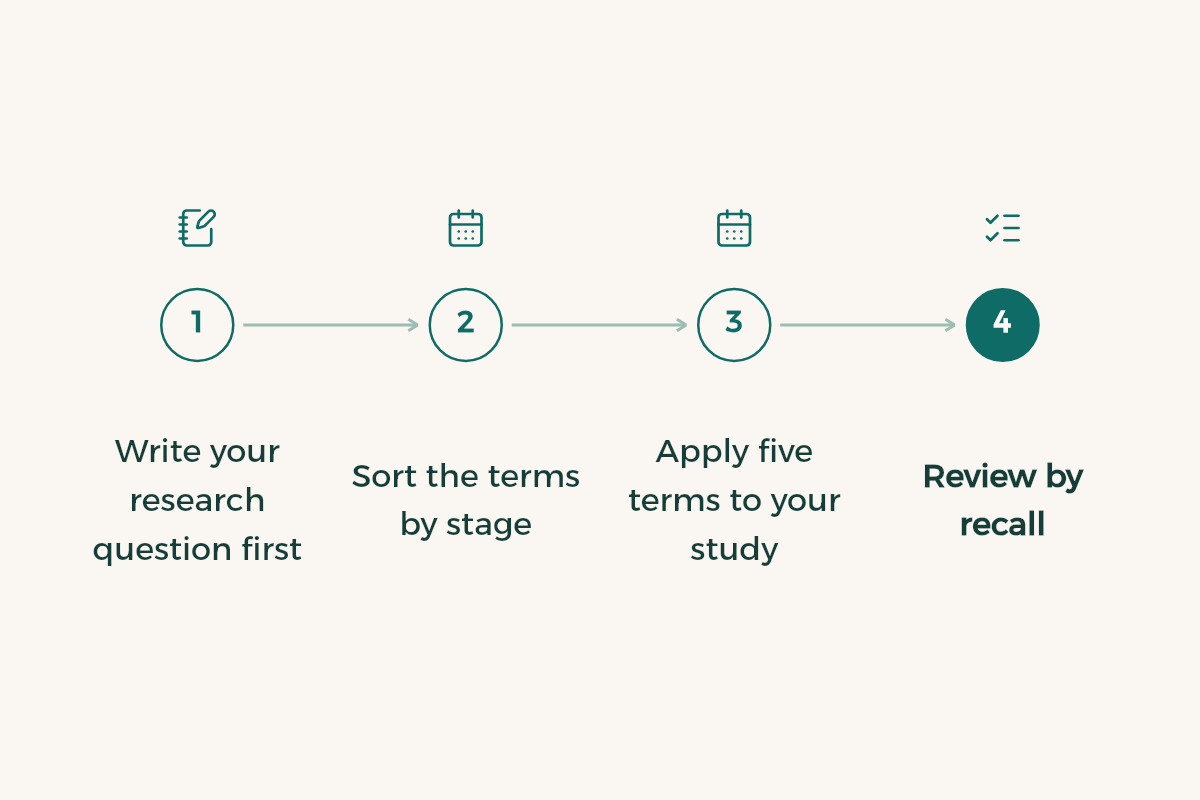
- Write your research question first
Before memorising anything, write your question and hypothesis if you have one, then return to the table to see which terms apply.
- Sort the terms by stage
Place each term under the chapter where you will use it: proposal, methodology or results.
- Apply five terms to your study
Write a short paragraph on your method using at least five terms, then review it with your supervisor.
- Review by recall
Two days later, rebuild the table from memory. Active recall and spaced repetition explains why this works.
If you are starting a proposal, read how to write a research proposal before the full list, since the terms make most sense once you know what you need. For the review chapter, the literature review explains structure and sources.
If you rely on AI tools to find studies or analyse data, read AI for research papers first. Tools can invent references that do not exist, so check every source in a reliable database.
Research sits at the heart of several majors. If you are studying psychology, public health or economics, look at psychology, public health and economics to see how research is done in each field.