By the tiswa editorial team, from the official sources listed at the end of this guide. How we write our guides
You open the physics plan and see two differently named courses: general physics and calculus. You assume the first is easy because you studied physics in school. Then in lecture three the instructor sets a problem with a varying force and an integral. That is the gap between school physics and university physics: the second is solved with mathematics, not with ready-made formulas.
What are the first year physics courses?
Each Saudi university posts its plan on its programme page, and no single list applies to all. Read yours by family. A well-known benchmark helps: MIT’s Classical Mechanics course is described as the first course in its physics curriculum and introduces space, time, mass, force and motion.1 Your names may differ; the content is what repeats.
| Family | What it asks of you | What to practise first |
|---|---|---|
| General physics (mechanics) | Motion, forces, energy and problem solving | Unit conversion and reading the problem |
| Mathematics (calculus) | Derivatives, integrals and applications | Basic differentiation rules |
| Physics laboratory | Measuring, recording and error analysis | Writing a measurement with its unit and uncertainty |
| Computing and programming | Numerical solving and spreadsheets | A spreadsheet and a simple plot |
| Language and skills | Writing and presenting a scientific report | Scientific vocabulary in English |
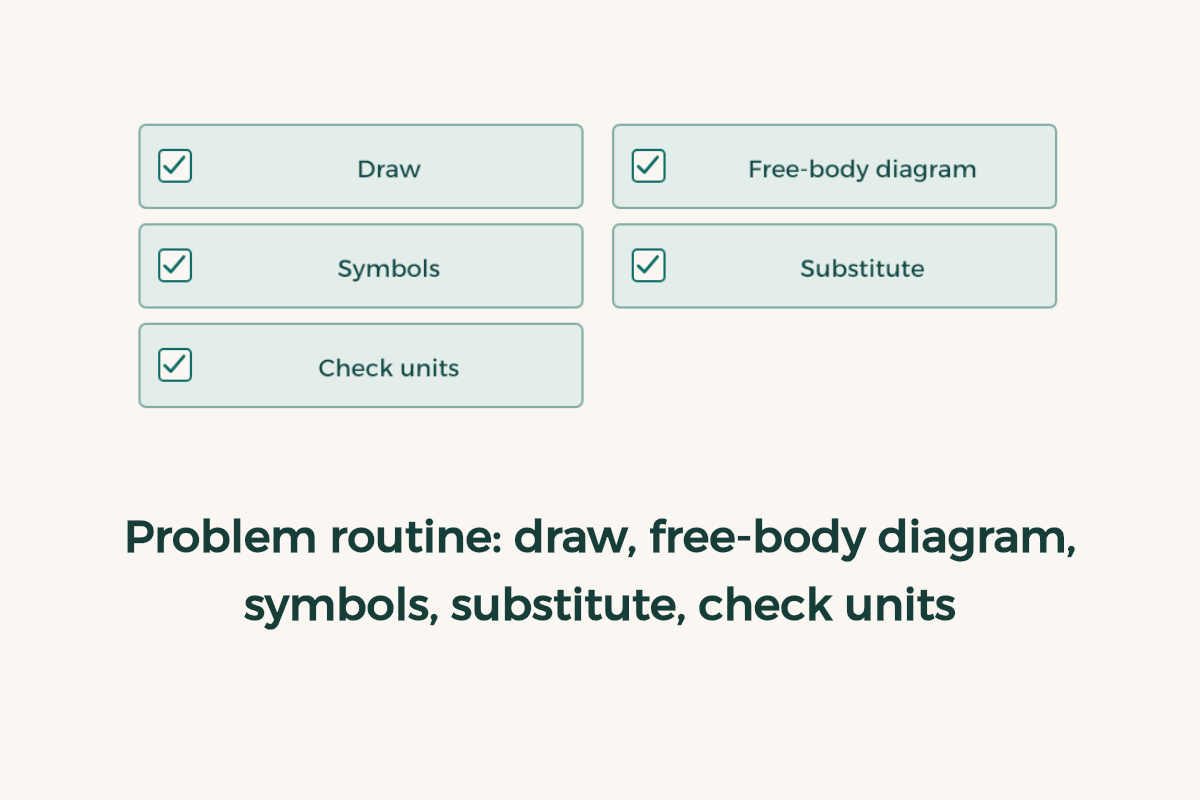
These are example families, not course names. A theory course and its lab may have separate codes, and calculus may be a prerequisite or a co-requisite. Note code, credit hours and prerequisite for each, and open the course page on Blackboard when it is live.
How do you study physics well?
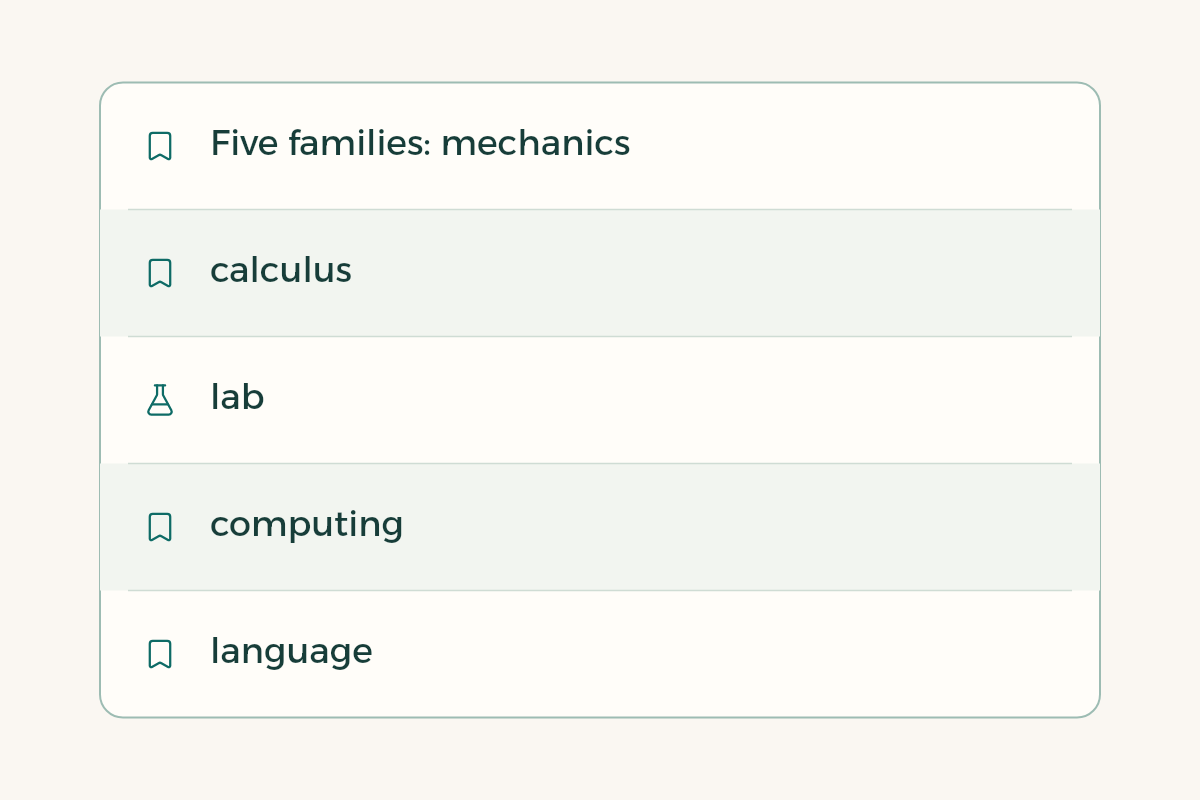
Physics is studied by solving, not by reading. Read the law once, solve five problems, then go back to the law and ask why. The good method is one routine for every problem: draw, write the givens with units, choose the law, solve with symbols first, then substitute and check units and plausibility. For the solving habit itself see maths problem practice, since the method is the same.
- Sketch the situation
Even when it looks simple. Mark the body and the directions.
- Draw the free-body diagram
One arrow for each force on the body. If you cannot say where a force comes from, it is not there.
- Write the equation in symbols
Do not substitute numbers until you reach the final formula. That is how you see whether the units are consistent.
- Substitute and check
Is the final unit right? Is the number believable? A car reaching 3000 metres per second is plainly wrong.
A practice example with invented numbers: a 4 kg box on a smooth surface is pulled by a 12 N horizontal force. Acceleration = force ÷ mass = 12 ÷ 4 = 3 m/s². Dimension check: a newton is kg·m/s², so dividing by kg gives m/s² as expected. That check exposes a flipped formula before you hand in. The SI unit definitions are kept by the BIPM.2
What is the English name of the physics major?
Physics, usually offered in the college of science as a Bachelor of Science in Physics. Many systems code physics courses as PHYS followed by a number, so check your university’s coding. A free university-level text, OpenStax University Physics, covers mechanics with worked problems.3 To see the paths after year one, read the physics major guide.
What mistakes repeat in first year physics?
The first is memorising laws without their conditions: the constant-velocity formula fails when there is acceleration. The second is ignoring units until half the marks go because the answer says 5 and not 5 N. The third is leaving calculus until after midterm, even though lectures lean on it from week three. The fix is a weekly table: two hours of calculus, three hours of physics problems, one session on the lab report.
One exception: if you studied physics under a different system in school, such as an international curriculum, you may need more calculus review than your classmates. Ask your academic advisor about support courses before the second week ends, and check the add-and-drop rules, which differ by university; the Ministry publishes the general framework.4
How do you write a physics lab report?
Write the aim, the apparatus, the data in a table with units, the calculations, the sources of error, then a two-line conclusion. Tie every number to a measurement you recorded, not a value from the textbook. Use an exam error log to turn each mistake in the first report into a checklist item for the second. At the end of the week, redo from scratch one problem you got wrong, without looking at the solution.
For planning before term, compare your plan with open material: MIT’s mechanics course is free online with lectures and problem sets, and its topic list shows where your weeks are heading. Your exam will not follow the same order, but it gives a first map. If a course description is missing from the site, ask the department or your university’s deanship of admission and registration, and put quiz dates in your phone calendar in week one, since short quizzes often start before the term feels started.