By the tiswa editorial team, from the official sources listed at the end of this guide. How we write our guides
KAUST does not run a scholarship competition. It runs an admissions competition, and everyone who wins it is funded: all admitted MS and PhD students receive the fully funded KAUST Fellowship1. The university is blunt that competition is high and strong grades are essential1. So the useful question is not how to win the fellowship. It is how to get into KAUST.
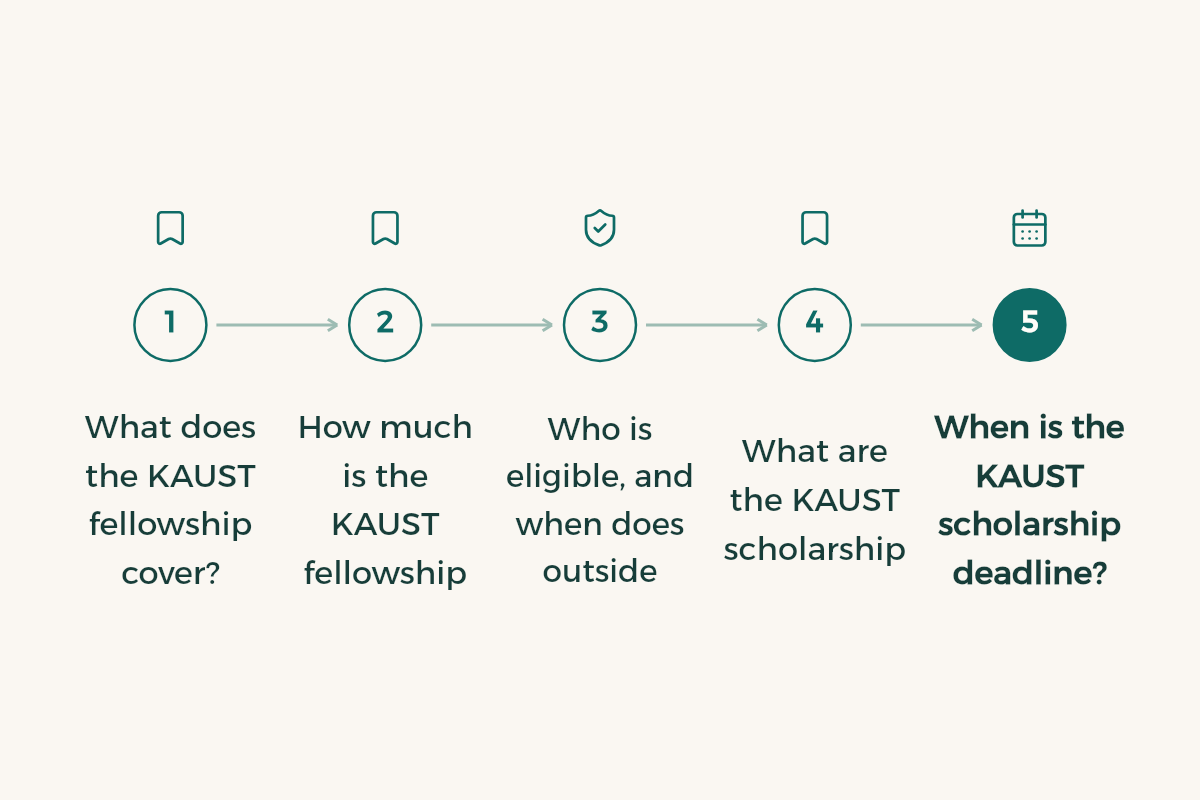
What does the KAUST fellowship cover?
The fees and funding page puts numbers on it3:
| Item | What you get |
|---|---|
| Tuition and bench fees | Fully covered, worth up to USD 35,000 a year |
| Stipend | USD 20,000 a year (MS); USD 25,000 to 30,000 a year (PhD), by qualifications and progress |
| Housing | Shared for single students, a 2-bedroom unit for married students; upgrades cost extra |
| Health insurance | Student and eligible dependants living on campus |
| Relocation | Visa, travel and moving costs for the first move and the trip home after graduation |
| Total value | About USD 70,000 to 80,000 a year |
The cost-of-living page adds utilities to the list2, and the full terms arrive with your offer3.
How much is the KAUST fellowship stipend per month?
Divide by twelve and an MS stipend comes to roughly USD 1,670 a month. KAUST says a recent student survey found average spending of USD 1,320 a month, with lifestyle making most of the difference2. A PhD student starts higher. Campus transport, gyms, pools, two beaches, off-campus shuttles to selected places and fast internet come free2; some leisure classes charge fees, and golf or scuba diving is on you.
Who is eligible, and when does outside funding rule you out?
KAUST says some students with external sponsorship or funding may not be eligible3. That test is separate from admission. You can be admitted and still sit outside the fellowship.
The people this catches: an employee whose company keeps paying a salary during the degree, a government-sponsored student from another country, a researcher with a grant from a home university. If that is you, write to admissions before applying and name the sponsor and exactly what it pays. Saying you have some support gets you a vague answer.

What are the KAUST scholarship requirements?
An MS needs a relevant bachelor from a recognised institution; a PhD needs a relevant master, and professional master degrees do not count as equivalent4. You must be at least 18 on entry. The GPA floor is 3.0 out of 4, yet about 90% of admits are above 3.3 and 75% above 3.54.
- IELTS 7.0 overall with 6.5 in every section, or PTE Academic 71 (67 per section), or Cambridge C1/C2 185 (176 per section). Scores stay valid for two years.
- Duolingo only counts for visiting students.
- GRE is optional.
- A statement of purpose of about 750 words.
- Three referees on academic email addresses, who upload letters themselves within seven days of the deadline.
In-person degrees from accredited universities in the US, Canada, UK, Ireland, Australia or New Zealand can exempt you from the English test4. Work on the score with the IELTS guide, and on the essay with how to write a statement of purpose.
When is the KAUST scholarship deadline?
There are two rounds a year5. Round 1 feeds the spring intake and is for PhD applicants only. Round 2 feeds the fall intake and covers MS, the MS/PhD pathway and PhD. KAUST calls its dates tentative and says they can move with application volume5. Take them from the admission timelines page each year, submit every document, and answer interview invitations fast.
The MS/PhD pathway runs 5.5 to 6 years and lets you move into the PhD without reapplying, if you meet progression requirements1. Not every programme offers it, across the 17 subjects KAUST teaches1.
Getting to Thuwal
KAUST sits in Thuwal, postcode 23955-69002. The fellowship pays for the visa and the move3. On the Study in Saudi platform the long-term student visa lasts one year, renews annually and asks for a passport valid 6 months from entry, a medical report and insurance6. For the first weeks, read international student life in Saudi Arabia.
Mistakes that sink applications:
- Sending a Duolingo score.
- Using a work referee when your last degree finished under three years ago; professional referees only count after three years.
- Leaving a sponsor off the form and finding out after the offer.
- Submitting on the last day, when referees have just seven days after it.
Weighing other routes? See the PhD in Saudi Arabia guide and scholarships for non-Saudis.