By the tiswa editorial team, from the official sources listed at the end of this guide. How we write our guides
In week seven of the first semester a message lands in the cohort group: the first midterm is in eight days. A student who used to study for two nights before every school test sits down and reads chapter one, then two, then three, in order. On day four he realises he does not know what is actually being asked. The first university exam is not harder, but it is different: the material is bigger, the lecturer does not remind you, and nobody tells you what will come up.
Most of the answer is already written down. What follows is a way to read your course documents and build a revision week. Exam details are the lecturer’s to give, so anything that is only an illustration here is labelled as one, and we claim no rule that belongs to a particular university.
How do you read the course specification before a first exam?
The course specification is a document the department gives you, or the lecturer posts on the university portal or hands out in the first lecture. It usually lists the course objectives, the topics and how you are assessed. Carnegie Mellon’s teaching centre advises writing objectives with measurable verbs,2 so the verbs tell you the kind of question: “define” points to recall, “analyse” to a problem or case. Read it with a pen, not like an advert.
- Find out what the exam covers
Is it lectures one to six or the whole course? Do not assume. If it does not say, ask the lecturer after class or by email.
- Find out marks and format
How many marks? Multiple choice, essay or problems? Is a calculator or formula sheet allowed?
- Turn objectives into a topic list
One objective per line, with the lecture or chapter that covers it next to it.
- Estimate the weight of each topic
A topic that took three lectures weighs more than one that took a single lecture. Marks on assignments and quizzes show what the lecturer values.
- Write down what you do not know
Anything unclear goes to the lecturer a week before, not on the last night.
How do you build a one-week plan for the exam?
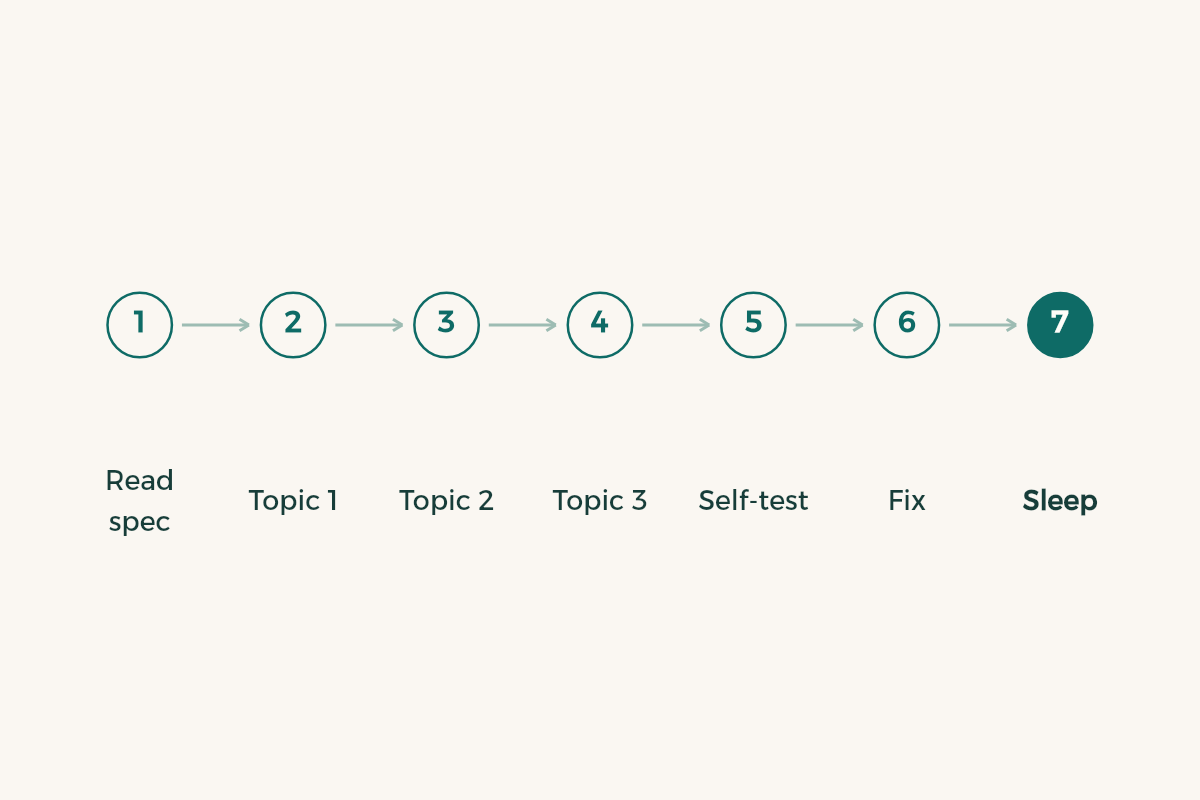
This is a table for an imaginary week, for an exam on three topics. It is a prompt for your thinking, not a ready template. Move the days around to fit your lectures and assignments. For larger schedules, see the study plan template.
| Day | What you do | Rough time |
|---|---|---|
| Seven days before | Read the specification, fill in the topic list, ask the lecturer | One hour |
| Six days before | Topic one: read, then write questions | Two hours |
| Five days before | Topic two: read, then write questions | Two hours |
| Four days before | Topic three: read, then write questions | Two hours |
| Three days before | Self-test on all three topics under real timing | Ninety minutes |
| Two days before | Fix the mistakes and retry the missed questions | Two hours |
| The day before | Light review, pack your things, early night | One hour |
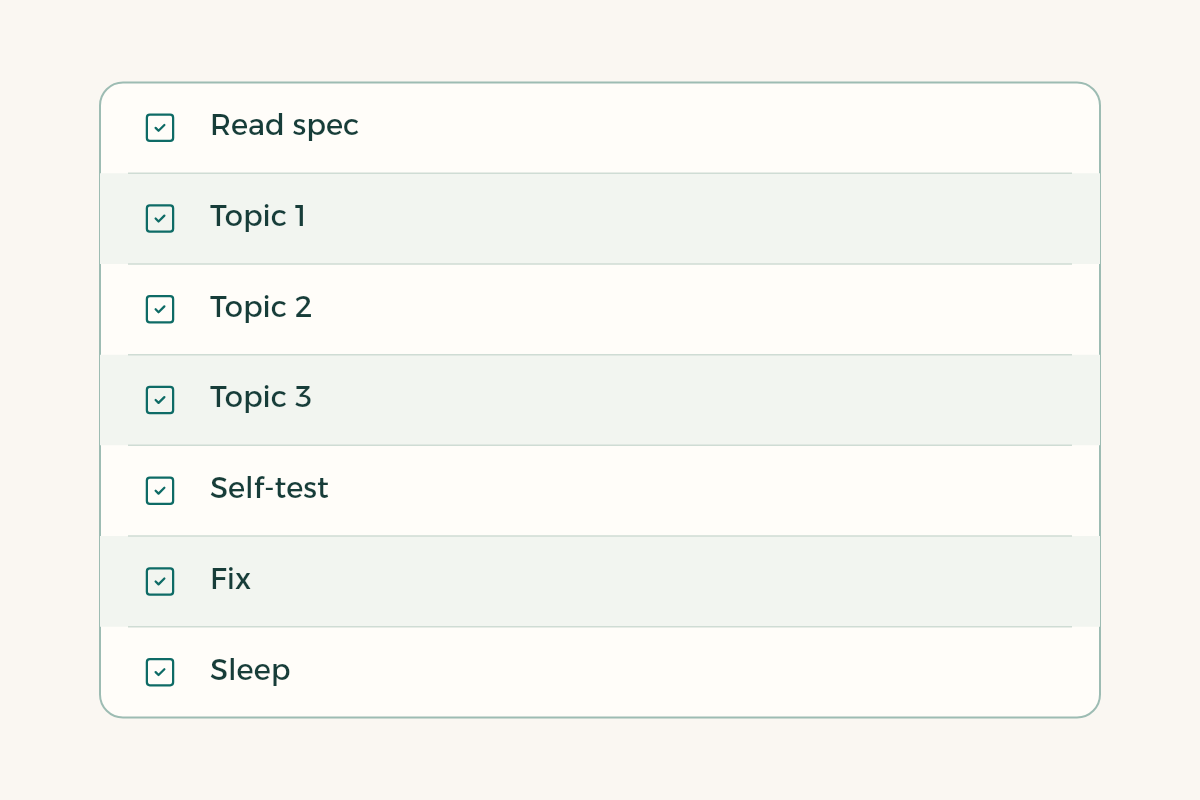
Notice that four of the seven days involve writing questions or testing yourself. That is deliberate. Roediger and Karpicke found that students who tested themselves kept more after a week than students who only read,4 and Dunlosky and colleagues rated practice testing among the most useful techniques.3
What should I do in the last days before my first exam?
In the last two days, do not start new material. Fix the errors your self-test exposed, review the formulas or definitions you keep forgetting, and go back to the questions you missed. Cornell’s Learning Strategies Center suggests practising with exam-like questions and planning how you will manage your time in the paper.1 The night before is for sleep, and we have put what it needs in the night before an exam guide.
For the morning itself, use the exam day checklist: ID, pens, the permitted calculator and arriving early. For the wider picture on midterms, read the midterm exams guide.
What if the material is bigger than the week?
Then cut to what carries the most weight. Rank your topics from the heaviest to the lightest and start at the top. If the week cannot hold them all, leave the last one for a quick review, never the first. Then ask the lecturer about the high-mark topics, who may tell you they sit in chapters two and four.
If you feel very far behind, do not try to make up everything in one night. Write down what you understand well, what you half know and what you have never opened, and start from the middle group. That protects your mark better than trying to read everything.
Should I study with classmates?
Yes, but after you have studied alone. Meet to swap exam questions each of you wrote, not to read the summary aloud to each other. Keep the session to one hour with a timer, and split up afterwards.