By the tiswa editorial team, from the official sources listed at the end of this guide. How we write our guides
Mundus MAPP, the public policy master's, sets one date that decides whether a Saudi applicant is considered for its scholarship: 1 December 2026 at 23:59 Central European Time.2 Applicants who miss it can still apply, but without aid and before 15 April 2027.2
What does the Erasmus Mundus scholarship pay?
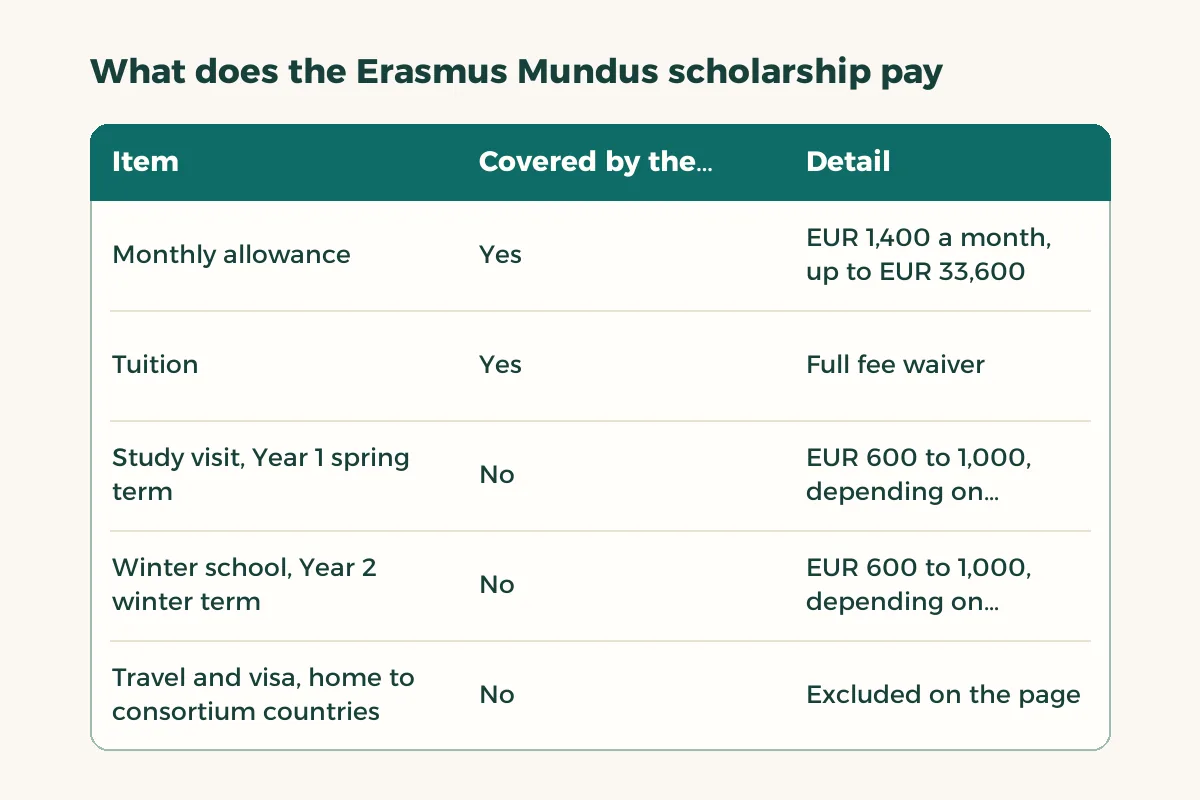
The Erasmus Mundus Joint Master (EMJM) scholarship is calculated at EUR 1,400 a month, up to EUR 33,600 across the 24-month programme, and it waives tuition in full.1 The page says the monthly sum is meant to help with travel, visa, settling in, subsistence and other costs, and the exclusion list shows where that help stops. Extra funding exists for students with disability or support needs, scaled to need.1 MAPP applicants also do not pay the CEU application fee, unless they apply to other CEU programmes.1
| Item | Covered by the scholarship? | Detail |
|---|---|---|
| Monthly allowance | Yes | EUR 1,400 a month, up to EUR 33,600 |
| Tuition | Yes | Full fee waiver |
| Study visit, Year 1 spring term | No | EUR 600 to 1,000, depending on destination |
| Winter school, Year 2 winter term | No | EUR 600 to 1,000, depending on destination |
| Travel and visa, home to consortium countries | No | Excluded on the page |
| Move to the Year 2 university | No | Excluded on the page |
| Health insurance | Bought by the consortium | For the study period, plus 2 weeks before and 2 months after |
The EU's own page describes Erasmus Mundus scholarships in general terms only. They cover participation costs and contribute to travel, visa and a living allowance, and the page gives no euro figure.4 The EUR 1,400 and EUR 33,600 figures belong to MAPP, so attribute them to MAPP.
The MAPP page contradicts itself on one point. It says the monthly sum helps with travel and visa costs, then excludes travel and visa costs between your home country and the consortium countries. Treat the sum as a contribution, not a guaranteed payment, and budget for your flight and visa until the consortium confirms otherwise in writing.1
Is a Saudi student eligible for Mundus MAPP?
Yes, if your degree and grades clear the bar. Saudi applicants count as non-EU applicants, and the scholarship is open to outstanding applicants from inside and outside the EU.1 The EU page adds that joint masters are open to students from all over the world, and that students apply directly to the institution running the programme.4 The FAQ sets the academic rules:3
- A bachelor's degree of at least three years from a recognised university.
- At least Class 2.1 (Upper Second), where that classification applies.
- A GPA of at least 3.17 on a 4.0 scale, or equivalent, given on that 4.0 scale in the application.
- A social-science degree, which the page says is generally preferred.
- Not eligible: bachelor's degrees in natural sciences or engineering.
The FAQ names two conversion tools, Scholaro and WES iGPA. It does not explain how a Saudi transcript converts, and we found no Saudi-specific guidance.3 Ask the programme to confirm your converted figure in writing before you submit, rather than trusting an online calculator alone.
How do I request the scholarship inside the application?
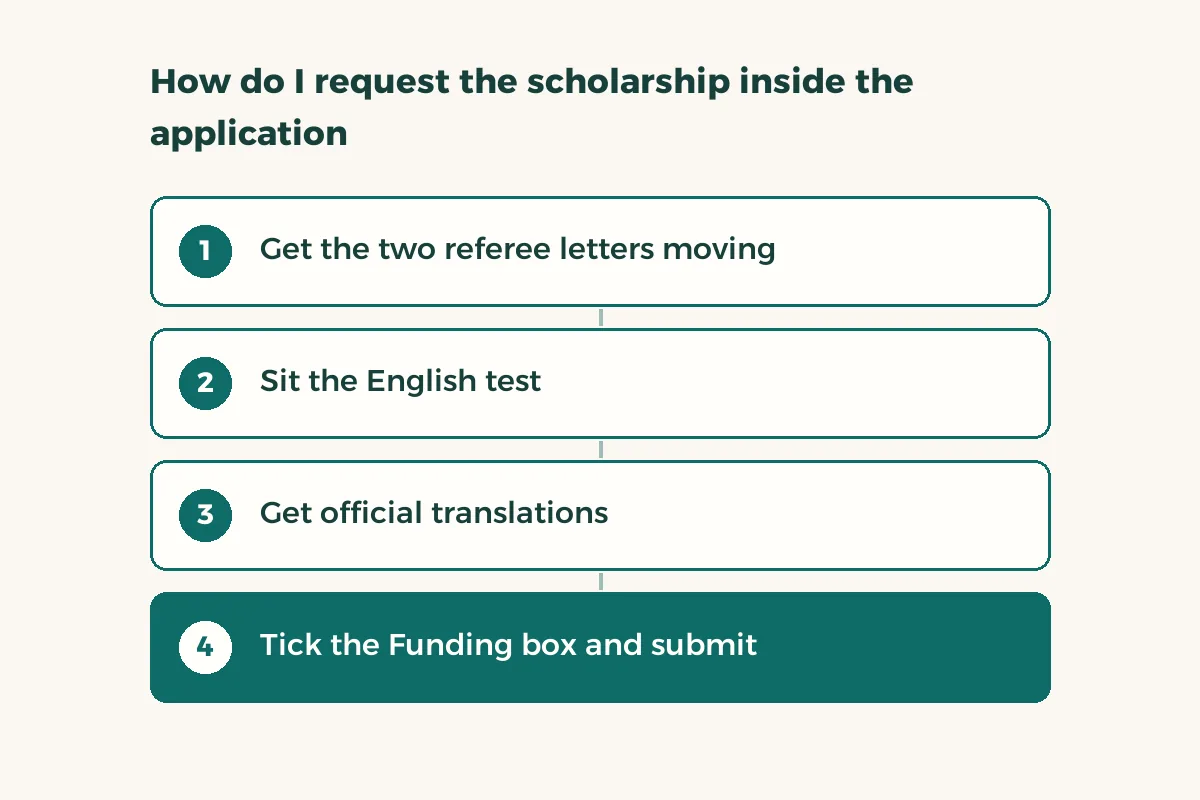
You do not file a separate scholarship form. In the Funding section of the admission form you say whether you want to be considered for financial aid, and applicants who want it must use the earliest deadline.3 The steps below cover the parts that take time:
- Get the two referee letters moving
Two confidential letters in English, from faculty or a job supervisor. Referees receive a link after you submit and have 7 days to upload. Letters sent by email, fax or post are not accepted.3
- Sit the English test
Scores go into the online application, and late submission is not allowed. Accepted: TOEFL iBT 95 or more, IELTS Academic 7 or more taken within two years of the deadline, Cambridge C1 or C2, PTE Academic 76 or more, or Duolingo 130 or more.3
- Get official translations
They need the stamp and signature of a sworn translator or the issuing institution, plus an English statement of authenticity. The sworn-translator list applies only to accepted IBEI-track students, not to applicants.3
- Tick the Funding box and submit
Indicate that you want to be considered for financial aid, and submit by 1 December 2026, 23:59 CET.12
The English exemption list names countries such as Nigeria, Kenya, the UK and the USA. We did not find Saudi Arabia on it, so plan to sit a test. Waivers are possible for an English-taught degree from a listed country.3
When are the deadlines and results?
The financial-aid deadline is 1 December 2026 at 23:59 CET, and first-round decisions, including the scholarship, come out on 14 April 2027.2 The rest of the calendar runs as follows.
| Date | What happens | Who it applies to |
|---|---|---|
| 1 Dec 2026, 23:59 CET | Deadline to be considered for financial aid | Scholarship applicants, and the early deadline for self-funded applicants |
| 14 Apr 2027 | First-round decisions, including the EMJM scholarship, published in the Applicant Portal | First-round applicants |
| 15 Apr 2027, 23:59 CET | Deadline without aid | Non-EU/EEA residents not applying for aid |
| 20 Apr 2027 | Deadline for appeals against first-round decisions | Appeals on procedural grounds only |
| 30 Jun 2027 | Decisions for self-funded non-EU/EEA applicants | Self-funded non-EU/EEA applicants |
| 1 Jul 2027, 23:59 CET | Deadline without aid | EU/EEA residents not applying for aid |
| 31 Jul 2027 | Deadline for official academic records | All tracks |
The time zone matters. 23:59 CET on 1 December 2026 is 1:59 a.m. on 2 December in Saudi time (UTC+3), which is our conversion from the calendar's stamp.2 Two extra hours are not spare time, though. Upload your transcripts and letters before midnight Saudi time, so a slow connection at 1 a.m. does not decide your file.
Can I defer if my visa is slow?
No, except in exceptional cases. The consortium does not grant deferrals for visa or financial reasons, and it reviews any exception case by case. It encourages applicants from visa-sensitive countries to apply by the first deadline.2
Can I combine this with another scholarship?
Not with another EU-funded scholarship. A holder cannot receive another EU-funded scholarship for the same or another EMJM master during enrolment, and anyone who has already held an EMJM scholarship cannot apply for another.1 The institutional scholarship is a separate award: one per study track, a 50% tuition waiver in Year 1 and Year 2, and no stipend.1 The page says places are few, so it advises looking for outside funding too, and it links partner-institution scholarships (ISS, IBEI and CEU) for admitted students.1
What do the official pages not answer?
The pages leave five questions open:
- How many scholarships the 2027 to 2029 cohort will get. The page says only that places are limited and awarded on academic merit.
- Whether Saudi Arabia has a quota or co-funding for MAPP or for any EMJM programme. No page we opened mentions one.
- What EUR 1,400 is in riyals, and when and how it is paid. We did not check an exchange rate or a payment schedule.
- Whether flight or visa money can be claimed back. The exclusion list names no alternative.
- Whether other EMJM programmes use the same 1 December date. We limited this guide to MAPP and did not check the others.
The FAQ refers to the 2026 to 2028 cycle, while the calendar covers the 2027 to 2029 cohort. We used the FAQ's rules, so confirm them on the form before you rely on them.3
Which mistakes do applicants make?
Most of the errors come from treating one programme's dates as the whole scheme.
- Reading 1 December as the deadline for every Erasmus Mundus programme. The EU page gives a general October to January window for most joint masters, and each programme sets its own date.4
- Skipping the Funding box, then finding out the aid deadline has passed.
- Budgeting the EUR 1,400 as if it pays for the flight and the visa.
- Emailing referee letters, which the online form does not accept.
- Entering a Saudi GPA as it appears on the transcript when the application wants a 4.0 scale.